Showing posts with label agriculture. Show all posts

Monday, May 30, 2016

Breed Spotlight - Cayuga Duck


Image Source: Wikipedia Commons

The Cayuga duck is an American breed of duck, originating from the state of New York. This breed is characterized by it's black feathers, which are iridescent  in the sun. They are among the oldest American duck breeds, and have been fairly popular since the mid 1800s. 


Traits of the Breed

Image Source: Wikipedia Commons
The Cayuga duck has black feathers, with a beetle green iridescence in the light. They are as close to solid black as it gets - their bill and legs are black, and their eyes should be very dark brown. This medium-sized breed weighs between 7 and 8 pounds, and are a dual purpose breed, once being the most popular duck for meat before the Pekin was imported to the US. One reason this breed is desired among backyard keepers is the eggs that they produce. High-quality ducks produce black eggs, although they slowly fade to light grey as the female's egg cycle progresses. Cayugas are known for being good foragers, but also being quieter than other breeds such as the Pekin, making them a good choice for the urban duck enthusiast. Male Cayugas are frequently mute!


History

The history of the Cayuga duck is fairly unclear. The breed originated in the state of New York and is named after Cayuga Lake, of the Finger Lakes region. One theory states that a miller in Duchess County found a pair of black ducks on his property, and bred them to get the Cayuga breed. Experts disagree, and say that there is no evidence to support this claim. A more likely theory is that the breed derives from the English black duck, which were once popular in England. These black ducks were then bred to mallard ducks, leading to the breed as we know it today. Although the origin is still unknown, it is most likely that the Cayuga originated from these domestic black ducks, rather than mutated wild populations. 

Cayuga ducks became less popular when the Pekin was imported from China, as their black feathers made their carcass less desirable on the table than the Pekin's soft white. The Cayuga is making a comeback as backyard enthusiast are often attracted to their beauty and novelty over the utility of other breeds. 

Where to get them

As Cayugas have become common among backyard farmers, they are available at most large hatcheries that sell ducks. For the best, show-quality and darkest eggs, you should buy them from a breeder with stock proven in shows, who will show you his/her birds' eggs before you buy the ducklings. 
Hatcheries:

Sources:"The Livestock Conservancy." The Livestock Conservancy. The Livestock Conservancy, n.d. Web. 30 May 2016. <https://livestockconservancy.org/index.php/heritage/internal/cayuga>.

"Cayuga Duck." Wikipedia. Wikimedia Foundation, n.d. Web. 30 May 2016. <https://en.wikipedia.org/wiki/Cayuga_duck>.

Tuesday, March 29, 2016

A Few Things That the Chicken Books Didn't Tell Me

When I first got chickens, I read every piece of material I could get my hands on. Books, magazines, pamphlets, anything! While these helped me learn a lot of things I needed to know about caring for chickens, they didn't tell me everything. My chickens have taught me plenty of funny, joyful, and painful lessons, from not-really-significant to pretty darn important.

They're smarter than you think


Sylvie, our very intelligent chicken!
The books told me that chickens weren't entirely stupid, but they didn't tell me they could be as smart as they are. So, our entire bantam flock feels like they need to roost on our porch, rather than the safety of their coop. This means every night we have to carry the five bantams and one overly docile salmon Faverolles in to their coop. One of those bantams, a silver Sebright named Sylvie, really doesn't like to be caught! While the others have given up on evading capture and just let us pick them up and put them to bed, Sylvie has adapted to every single method we have thought of! She quickly caught on to the first method of "catch her while she's asleep". So, since chickens can't see well in the dark, we came up with a new method. "Point the light in the other direction so she can't see us coming to grab her". Eventually, she figured out where the light was coming from, and that we were slowly moving towards her. Off she flew. Then, our new method "catch her in complete and total darkness" worked for a couple of months. But eventually she started listening to our steps and flying off as soon as we got close. Our newest method, "walk past her as if you're not trying to catch her and grab her before she realizes what you're doing" probably has about a week left. Sure, keeping her in the coop and not letting her free-range would solve the problem, but that's no fun!

Don't wear flip-flops in the coop

For some reason, I didn't think of this before getting chickens. No book has ever advised me not to wear flip-flops, but they should! If you have a freckle, or your toenails pained, a scratch or even a spec of dirt, the chickens will feel the need to peck it. A lot. I have one teenie, tiny freckle on my left foot, and every time they saw me in flip-flops, they tried to peck it off, and do the same to my painted toenails. For a quick, cool slip-on shoe, I recommend nurses shoes!

You will spend way more time watching your chickens than you thought

For some reason, chickens are fun to watch. Many owners refer to this as "chicken TV." Watching "chicken TV" is like listening to waterfalls or watching a nature documentary, it is calm and relaxing. In a world where we are constantly stimulated by our devices, chickens provide an outlet to observe something with no story and no problem solving. It's a type of entertainment that allows us to take a moment to just watch and enjoy animals doing what animals do - and that is a lot more satisfying than it sounds! Sometimes I spend an hour just watching them out my window as they peck around, and my rooster periodically chases his son away from the hens. After watching them, I feel very relaxed and entertained, even without my smartphone in my hand. 

The first chicken death is really hard... but it gets easier

 One of the most unfortunate things about keeping livestock, especially chickens, is that they are prey animals, and they die often. While a chicken can live for 10 years or more, it's more common for them to first be taken out by a predator, illness, or simply failure to thrive. My first chicken death was also my favorite chicken, named Blossom. We had let the chickens out to free range, but had to leave for the hospital due to a family emergency. When we returned, blossom was in the driveway with a note from our neighbor that she had been hit by a car, and he didn't want us to see her lying there in the road (thanks for very kind neighbors). That was very hard, but it prepared me for the following year. That summer we had a dog attack and an outbreak of coccidiosis that took out several of my spring-hatched birds both times. Each time, it got a little easier to deal with. It's still a little upsetting when one dies, but now that I have twenty-something birds and I have experienced a few chicken deaths, it doesn't make me want to give up. Even if an illness wiped out half of my flock, I could now learn to cut my losses and start over. I believe this has helped me a lot in life.


You probably won't get just a few chickens

Commonly referred to as "chicken math," this is a more serious problem than you would think. After our first six hens, we got a rooster. We figured we could hatch some new hens, since our coop had enough room to nearly double the flock size. Now we have two coops and a duck pen, and we are adding a bigger coop and a fence for waterfowl. We are adding several chicken breeds, one or two more ducks, and most likely a goose or two. This all started from getting six pullets from Tractor Supply. This is something you'll have to be careful about if you live in the city, where they usually have limits as to how many hens you can have. If you don't live somewhere with ordinances, plan for expansions. Chicken math will get you!

Nothing tastes better than the food your chickens provide you

So, maybe a home-grown chicken egg tastes just like a storebought egg in a blind test. Maybe it does cost twice as much to raise chickens than just buy eggs. But producing your own food, collecting those eggs that are waiting on you every morning, eating an egg for breakfast that is just hours old, it's rewarding! When you were a kid, and you grew a vegetable plant for school, nothing was better than when you finally got to eat it, no matter how gross is actually was. Something that is produced in your own backyard just tastes better to you. It gives you a sense of accomplishment! This is especially true in kids; I've had kids beg to collect the eggs for me when they come over!

I'm sure I will learn many more lessons throughout a lifetime of chicken keeping, as I have many more years to go. What have your chickens taught you? Leave a comment! Don't forget to check out our Facebook page and our Instagram for regular updates!

Wednesday, March 2, 2016

Getting your kids active in the backyard farm


Do your kids help out with the farm duties? They should! Your backyard barnyard has something to offer for every childhood life stage! Kid's love to help out, and they can learn so much through farm work and gardening! There is always something for them to do, from the toddling years until they're ready to fly the nest. Let's take a look!

Toddlers (1-3 years)

This is the time when children are learning to move and communicate. There isn't a whole lot they can do at this point, but shadow you. In the garden, you can bring them with you to "help" with the plants. You can give them a watering can so they can 'help' water the plants, or a basket to let them carry them back to the house. These simple tasks make a toddler feel like they are doing something, and sets the stage for more difficult future work. They also will watch you and try to repeat it, because children learn by example rather than being told what to do. 

Young Children (4-6 years)

Young children are quite capable of actually helping out now! Right now, they are learning values and morals that will follow them through the rest of their life! Now, you can assign farm duties with their regular chores. Add collecting eggs, watering vegetables, feeding and watering animals, etc. to the list. You may also be able start letting them help with more difficult tasks, such as milking goats, incubating eggs, cleaning pens, harvesting crops, and butchering animals. Now that your kids are completing tasks, a small allowance may be in order. This does more than just give your kids money to get what they want, it teaches them the correlation between working and money, and how to manage money early on.

It's best not to skip around the subject of death, because now is a good age to learn to deal with it, and a farm provides the perfect setting. Many farm animals are prey animals, especially rabbits and chickens. Some will die, and kids are very resilient when it comes to dealing with death. They look to their parents to figure out how to react, so as long as they are allowed to talk about their feelings and you handle it well, they will be fine. Never replace the death talk with "they ran away.." or "they went to another place" because that simply avoids the problem. If you're raising animals for meat, make sure your children are aware of that as soon as you get the animals, preferably before they meet the animals!

Older Children (7-11 years)

At this point, children are old enough to join 4H and can be assigned responsibilities, rather than tasks. If you're letting your child raise rabbits for their project, then those rabbits are their responsibility. Their job is to feed, water, weigh, and do everything they can to make those rabbits show-worthy and sell them at the fair. Unlike with younger children, where you assign them a few duties to help out, these kids will see the end product of something that was completely theirs. Even if they're not in 4H, they will see the benefit of the chicks they raised or hatched, or the plants they grew, and it will make them feel good about themselves! They will learn that feeling good and happy takes work, and that work is worth it. This doesn't mean you can't help them, however. If your child has any questions or is struggling, don't be afraid to demonstrate the proper way to do things. If you're letting your child incubate eggs, for example, make sure you teach them how to run the incubator first, and demonstrate candling to them before allowing them to do it. Now, they're really learning what farm work reaps and how to run one. If your child is not selling an animal in 4H, now may also be the time to increase allowance slightly as their workload will have increased (i.e. from $3/week to $6/week) to show them the correlation between the amount of work you do and the money you make. 

Teens and Tweens (12-17)

A very large age group, kids at this age are able to take on much larger responsibilities and really help out. They can be doing real farm work. They have mastered many agricultural skills. Depending on what type of setup you have, they may have learned how to build things, select animals for breeding, choose the best plants suited for your climate, and many more duties that you normally would take care of. Children of this age may not even need your help with tasks any more! This age is an important time to instill work ethic as teenagers do have a bit of a reputation for being lazy. While technology and entertainment are excellent in free time, it's good to keep your teenagers busy with more active tasks. Working on a backyard farm will get them outside, moving, and doing something meaningful. They are helping to produce food for themselves and the family, and that does a lot more for the soul and planet than 30 games of Candy Crush! 
 If you have a larger farm, this can be as much work as a part-time job for them, so, as with the younger ages, a raise in allowance may be in order, especially if they don't sell at a fair! Don't fret if your family can't afford a big increase in allowance, but if that is the case then you should probably allow them to do something to make money through your farm. For example, hatching and selling chicks or running a produce stand! You could even use this as an opportunity to teach your teen about business and investing - you can pay for chick feed, seeds, maybe even an incubator to help with start up costs, and you get a percentage of their profits. You may not break-even, but it's an excellent lesson that your child could use in the future!


Conclusion

Your hobby farm does a lot more for your kids than you may think. From providing healthy food, helping them manage their emotions, or learning work ethic and business. It is important to get all children involved around your barnyard, even if you just have a vegetable garden or chickens! Kids can be rewarded in many ways through farm work in ways both monetary and self-esteem. Growing up in a very agri-centric area, I noticed that the most confident kids were those raising animals and selling them at the fair! I strongly believe that such work will improve a child's self-esteem in a proper, genuine way. 
While many kids are bored and trying to find their own ways to occupy their minds, your children can be using that time to improve their life, health, and the planet! 

Thursday, January 14, 2016

The Spring Chick's First Snow

One of my favorite things is seeing the first-year chickens experience snow for the first time. Some stand there and stare at the sky, some peck at it, some go in the coop and won't come out, some go everywhere but the coop trying to escape!


Here they are hiding under some steps. Marquis, the Salmon Faverolle, is much more equipped to handle cold weather than the bantams. However, he stays with them because he is too timid and docile to be with the big chickens! He got use to the snow pretty quickly compared to the others!


Choco, a Golden sebright, could not understand the snow. She stood in that spot, with that expression, for about 10 minutes while I tried to get her in her coop. She was more confused than any of the other chickens - and it was hilarious!


After she was done staring at the sky, Choco tried to escape by getting on the roof. She was too confused by the snow around her to fly back off by herself, so I had to get a 4 foot stick and poke her until she got off the roof! I knew she could fly well, but not that well! 


All it took to get Sylvie and Mr. Fabulous use to the snow was a few graham crackers! They followed us straight into the coop! Since Silkies do not have any  hard feathers to keep heat in and water out, it is important that that stay dry in the winter. Sebrights are better, but they have very little underfluff to hold warm air against their bodies. It's best that the bantams don't spend to spend too much time in the snow!


Now the ducks loved the snow. I let them out and they immediately started playing in it! They loved sifting through the snow for the little pieces of food left behind by the chickens! Ducks are a lot more cold-hardy than chickens, but they aren't foolproof. I looked outside to see one of my mallard/pekin hens shivering. When I picked her up, she was soaked! She hadn't spread her oils well enough to fully waterproof her feathers! Always check your ducks' feathers in the winter!

Of course, Nina the farm Chihuahua. This isn't her first year of snow, but it may as well be, because she acts just as surprised and disgusted every year! Even though she has a sweater and a coat on, it's just too cold out for her!


I hope you guys enjoyed my flock and the snow! Stay warm, drink some hot cocoa, and make some cookies with your eggs (if you're even getting them right now!). 

Sunday, December 6, 2015

Best Chicken Breeds for Preppers

Doomsday prepping has become quite a popular hobby. It's no wonder, with the CDC releasing a zombie preparedness guide, and many possible tragedies the threaten life as we know it. Whether you're prepping for government collapse, the super volcano eruption, or a massive epidemic, chickens will be a valuable source of food to make you self sufficient. They are possibly the easiest livestock to care for and will provide both eggs and meat! However, not all chickens are the same, and some breeds would do better in a survival situation than others. I've come up with a list of my top picks. The list is in no particular order, and which ones are best depends on your climate and situation. The main factors I considered for this list are Use/Production, weather hardiness, free-ranging ability, raising young, and the ability to defend themselves. Some birds will be better at certain things than others, so I suggest a varied flock that covers all bases.


1. Rhode Island Red.


These guys are the jack of all trades. Originating from New England, they are very cold hardy, but can handle heat as well. They are great layers of large brown eggs, and very meaty birds for the table. Rhode Island Reds are decent free-rangers but will still need some supplemental feed, even in the summer and fall months. Roosters are extremely strong and protective of the flock, but this also means that they tend to be aggressive. Make sure children know to avoid the rooster and what to do if it becomes aggressive toward them. Hens are mildly broody, meaning they will hatch and raise chicks occasionally. 
Heritage birds (from a breeder) are desired over hatchery stock for this breed. Hatchery stock Rhode Island Reds (also called "production reds") have been bred for excellent egg-laying, sacrificing broodiness and size, so they are less desirable for dual-purpose uses. However, hatchery stock will still be good enough for the average prepper. Mine come from hatchery chicks! This would be an excellent breed to make up the bulk of your flock. 

2. American Game


American Games are the fighting fowl of the US. These beautiful birds are probably the toughest common chicken you can get! They are extremely flighty, and can evade most predators with relative ease. Their wings and tails are very long in comparison to their body size, making them perfectly equipped for flight! What they can't fly away from, they will fight. Because females often grow spurs as the males do, they are a force to be reckoned with to predators. Females are also excellent mothers, going broody and raising chicks several times during the hatching season. They protect these chicks with ferocity. 

In addition to being very good at protecting themselves and their young, this breed is very hardy and self-reliant. They can handle both heat and cold very well, can eat almost exclusively through free-ranging. Owners of this breed find that they often prefer to roost in trees rather than in coops, no matter the weather! They are practically wild birds, and can adapt to most any climate. They can have a pea comb or a single comb. Pea is preferred in cold climates, while single may be better in hot climates. 

The hardiness of this breed comes at a cost. They are not bred for production, so hens lay less than 100 eggs a year. Though they are muscular, they weigh less than five pounds, not making them much of a meat bird. In addition to that, these birds are born and bred for fighting and are very aggressive. Males can not be kept in confined environments with other males. Because of this, games should not make up a big part of your flock. Due to their flightiness and aggression, games are not ideal for beginners. 

3. Plymouth Rock


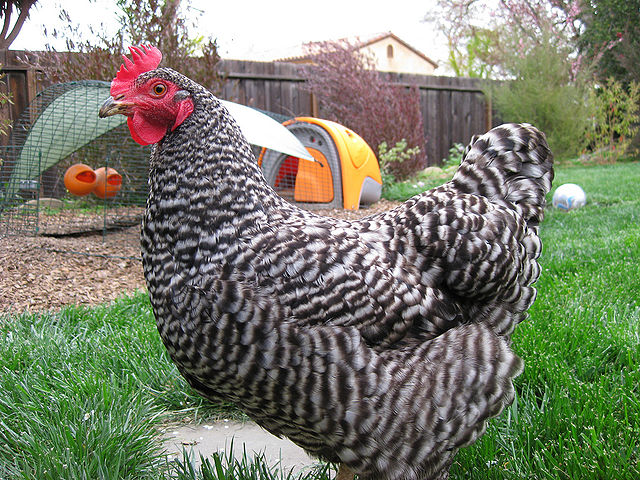
Stocky and cold-hardy, Plymouth Rocks are my personal favorite dual-purpose bird. They lay almost as well as the Rhode Island Red, but lay slightly smaller eggs and may lay a little less per year, especially comparing hatchery stock. They make up for it in their meat, however. Plymouth rocks are heavy, meaty birds. Both male and female can dress out at a decent size, and make for a tasty roast! Males are fairly protective, and not very aggressive. Females are moderately broody, and their size means that they can hatch a lot of eggs at a time.
While they will free range, their size requires that they have a lot of feed to supplement what they find.  This also means that they are poor flyers. 
Plymouth Rocks come in a lot of difference colors. Especially for free ranging flocks, barred or partridge colored varieties are best. White is the most easily spotted by predators, but the white pin feathers look better for butchering than that of darker birds. 

4. Orpington


Orpingtons, the pillow-pet of chickens. You can thank England for this fluffy breed, where they were developed into the excellent dual-purpose bird that they are today. They do fairly well in free-ranging, but will still require some feed, all seasons. Some people prefer Orpingtons over any other breed as a mother to chicks. They are very large, so a lot of eggs can fit under a hen. This breed also has an extremely calm, friendly temperament, making them a common pick for families with children. Roosters are generally not extremely protective, however. This breed is particularly cold hardy.
These birds have been bred for both eggs and meat, and lay medium to large eggs. Because they are a heavy breed, so each bird will have a hearty amount of meat for butchering. The most common color is buff, but they come in many more solid colors as well as patterns!

5. Leghorn


Sometimes pronounced "leg-horn", sometimes pronounced "leggern," Leghorns lay most of the eggs you see in the grocery store. This is because they are able to produce very large eggs, while their small bodies require significantly less food. In addition to laying lots of eggs on little food, they are great at free-ranging and excellent flyers! The brown variety of leghorn will be less susceptible to predators than the more common white. Males are known to be protective and are prone to aggression. They are generally not a mothering breed, however. They go broody very rarely. 
Leghorns will do very well in hot environments, but may do poorly in colder climates. Their large, floppy combs are prone to frostbite in the extreme cold. 

6. Easter Egger


The Easter Egger (often abbreviated 'EE') is not a true breed, but rather a mix of a blue laying breed, usually an Ameraucana or Araucana, with a brown or white layer. They generally lay blue or green eggs, but can lay pink, brown or cream as well. Hatcheries often label Easter Eggers as "Americana" to fool people in to thinking they are getting a great deal on the rare and expensive "Ameraucana" when they are, in fact, getting a mixed-breed bird. 
Nonetheless, Easter Eggers are inexpensive and extremely hardy birds. They are not very big chickens, but very resilient. They can handle heat or cold, but can deal with extremely cold temperatures better than most. An excellent choice for a northern prepper, EEs are great free-rangers and generally come in camouflaging patterns. They are mildly broody and make good mothers. They are a good layer of medium to large eggs that can be any color, but are most often blue or green. 
Easter Eggers are generally known to be quite friendly birds, but it can depend on the breeds a specific hatchery or breeder used in their birds' development. 

Breeds to avoid

There are plenty of birds not mention in my list that will do just as well as the above birds in a doomsday situation. However, there are a few you should probably avoid. 

Sebright


This breed is often in bantam bins at feed stores. They are striking in appearance which makes them tempting, but your main flock is best without them. They don't lay much, sometimes only laying a total of 4-6 weeks out of the whole year. They don't generally go broody, and they aren't particularly weather-hardy. Males have "hen feathering" due to a mutation that mutes the testosterone receptors in their skin that cause most roosters to have long, pointed, shiny hackle and saddle feathers. This mutation has led to reduced fertility among male Sebrights. They can, however, fly better than most chickens and mine do very well in a free ranging environment (guilty as charged, I have two.)

Silkie


Another I am guilty of owning. Silkies are an Asian breed of chicken that lack 'hooks' on their feathers. This causes the feathers to appear fluffy, as if the chicken has fur. Unfortunately, this mutation causes a lot of problems for the Silkie. They are unable to fly because their wings and tail cannot catch wind. They also cannot handle cool or windy weather very well. Normal chickens stay warm by trapping air between their feathers and their skin. That air is warmed by their body heat, and insulated by their feathers. Silkies' feathers don't do this very well. They also are not water resistant like a normal chicken's feathers, so they get soaked to the skin any time they get wet. 
Silkies do have a very calm demeanor, do well in confinement, and are good at raising young. They
may be a good option if you needed to keep a chicken indoors. 

Anything "frizzled"

It may be tempting to buy these adorable chickens that look like their feathers are permanently ruffled. However, they run into the same problems as Silkies. Those up-turned feathers are unable to insulate body temperature, making both excessively hot and cold weather difficult for them to handle. 

Polish


I personally do love the appearance of these goofy looking birds, but they aren't the best for a prepper. They lay modestly, but generally stop completely in the winter. They rarely, if ever, go broody. Polish could be good free-rangers, if it weren't for their giant crests making them predator bait. The crest blocks out most of their sight, making them unable to see any aerial predators. They also run into problems with other chickens who have not been raised with crested birds. They will peck at the crest, thinking they're getting some funny thing off of their flockmate's head, but they're actually scalping her. 


Your own flock

The best flock for a prepper is a varied one. As generations go on, the flock will combine their genes to produce well-rounded and diverse offspring, allowing you to continue your food source for a very long time. The chickens I specified are my personal top picks, but what you like or need may depend on your unique situation. Always do research on a breed before buying to see if it will fit in to your life! 


All images used in this article are either Public Domain, or owned by myself. 

Tuesday, March 24, 2015

Gardening with Limited Space

You love your city life. The proximity to everything you need and want, the city lights, the skyline. But maybe you want a taste of the country life, fresh veggies or herbs that you grow yourself! It may seem out of your grasp, but it's within your reach!
I once had an agriculture teacher who grew up in an apartment in town. While all of the other kids were raising goats, pigs, and lambs as projects for the county fair, he was struggling to figure out a good FFA project to do. The solution? Growing vegetables in his bedroom window!

What do I need to grow plants? 

You need light, soil, and water. Oh and a place to put them. Some folks also like to use fertilizer, such as miracle grow. This is fine, but I prefer to use nature's soil (yes, that means composted chicken poop!) If you have a pet rabbit or guinea pig, their poop is awesome as well!

Where can I put these plants?

I always start my plants in the big bay window in our living room. They receive the morning light, and then limited light throughout the day. Then, as they get bigger, I plant them in larger pots and eventually plant them outside. If you live in a suburban environment, this method will work perfectly fine! However, a fully urban setting probably won't allow you yard space to plant a big outdoor garden! Don't worry though, there are other ways!

Terrace garden

In this method, you plant in large pots and put your veggies on your terrace. They can really beautify the space, while also giving you fresh veggies and herbs!
I found a great blog about having a garden in the city - particularly terrace gardening!

Sun room

If you happen to have a sun room (a room with glass walls) This is a perfect place to grow plants. It's like a little greenhouse! Just like the terrace garden, plant in pots and arrange them in a way that suits you and the plants!

Saving space

Whether you have a small suburban backyard, a terrace, or a sunroom, it is important to save as much space as possible while still growing a decent amount of crops. 

Pallet Garden

One of my favorite methods of this is the pallet garden! Staple some plastic to the back of it, really pack in the dirt, plant, and then lean the pallet against a wall or fence! I like to grow smaller plants, like herbs, or vining plants in these gardens. Here is an excellent full tutorial on how to make a pallet garden: http://www.growingagreenerworld.com/creating-a-pallet-garden-step-by-step-instructions/

Mini Greenhouse

Ever wanted a greenhouse? You can make a tiny one for less than $30! A basic greenhouse is made of a square base (I prefer wood for this) and flexible PVC to create a "dome" shape, then plastic is stretched over the pipe. This type of greenhouse is light enough to be moved around. It is also cheap and simple enough to be torn down and reassembled each year! 
Here is a very useful article on a DIY mini greenhouse: http://www.dandelionking.net/do-it-yourself-greenhouse.php

How do I fertilize my garden?

You have a couple options when fertilizing your garden. How you do so depends on whether or not you want your crops to be considered "organic" or not. Personally, I prefer compost, because it is free!

Compost

If you live in an apartment or condo, you may think that composting is just not possible, but that's not necessarily true. Check out this article about indoor compost, and it's increasing popularity in Canada, and this post about personal experiences with indoor composting. If you're doing an indoor composter, do not attempt to compost meat. No amount of air freshener will fix that mistake. Stick to veggie scraps and poo from the pet rabbit/guinea pig/hamster. If you are doing an outdoor composter, there are mixed opinions on the matter. You can, but if you don't have a big yard or you have close neighbors, you may want to rethink it. Meat also may bring in animals to your yard. Most of my kitchen scraps go to my chickens, whose poop then goes into the compost pile. However, if the meat is spoiled and therefore inedible by even chickens, I put it at the bottom of the compost pile to decompose without horrid smells. We've done this for years and it's never been a problem! However, keep in mind, the bottom of my compost pile is buried under a couple feet of soiled straw and grass clippings. Remember to wash your hands after tending to composting materials (especially poop)!

Commercial Fertilizer

If you are growing organic, skip this completely. Realistically, there is little evidence to show that commercial fertilizer will actually hurt you at all. Studies suggest it has no effect on the body to eat plants that have been grown with commercial fertilizer as compared to organic food. So don't feel bad if you don't want to have a composter in your kitchen, it's not for everyone! A popular fertilizer than people use for flower gardens is miracle grow, and that will work fine for your run-of-the-mill garden veggies. Large companies and greenhouses generally use stronger commercial fertilizers, which I avoid because my skin does not agree with it, at all. Personally, I don't use fertilizers anymore because I have a free option, compost. If you use fertilizer, make sure you mix it properly and store the container properly. 

What plants should I choose?

What you should plant depends on what you want from your garden and what you have space for. 

Small apartments and condos

Veggies/Fruits - small tomato varieties, such as cherry tomatoes, are good options, and can be grown in a hanging  planter, like a bucket with a big hole drilled in the bottom, or a topsy-turvy planter! You can also grow a few single green bean (bush-type) or pea plants. Peppers are generally small plants (under 2') and can be  grown in a decent sized pot. Strawberries are excellent small plants as well, you could probably have one in your windowsill! 

Herbs - herbs are a pretty easy plant for small spaces. Most don't get extremely large, and make your house smell delightful. I enjoy growing basil, oregano, lavender, mint, and catnip (kitties just love it)!
You can use them fresh and raw to cook with, or you can dry them and crunch them up. You can dry the old-fashioned way, by hanging them up, or you can use a dehydrator. 

Suburban Home

Most likely, you can have a few plants outside, so you have a bit more freedom!

Veggies/Fruits - Tomatoes (whatever type you wish), green beans, wax beans, possibly potatoes, and peppers are  all good options for the average backyard garden. Corn should  generally be avoided, as stalks can be over 6' tall with some species. If you do wish to grow corn, choose a variety that have a shorter stalk. I've planed Ruby Queen Hybrid corn several times (suppose to be 7' tall) but each time grew just 3-4', yet with fully sized cobs! I have no idea why, as my other corn doesn't do this. As for fruits, you can do well with some properly-maintained berry vines. Many berry vines naturally have thorns, but you can get the thornless variety for easy harvesting - which I strongly suggest if you have children! Remember to trim them each year after they turn brown. Poorly maintained berry vines can quickly swallow up your backyard!

Herbs - Pretty much anything they sell in the lawn & garden department. You can even keep them inside if you want!

Happy Gardening!

I hope your garden does well, and all the veggies, fruits,  and spices taste absolutely delightful! May you and your family eat delicious, healthy food that is right at your fingertips! Above all, have fun with your garden, however you choose to raise it! 

Wednesday, March 18, 2015

Chicken Behavior: Normal or Abnormal

Sometimes, our chickens do things that we simply don't understand. If you have chickens, you've probably looked out your window and thought "That stupid bird, why on earth is it doing that?"
So, why do chickens do certain things, and what is normal for them to do?

What are normal chicken behaviors?

Normal behaviors in chickens can seem odd to us. However, for this article, note that there is a difference between "normal" and "natural" behaviors. Natural behaviors can change by the situation that the bird is in, and is driven by it's instinct, though it may not be normal because it's not something the bird does under typical circumstances. For example, cannibalism in chickens is not normal in a flock with plenty of space, but is caused by a natural instinct when overcrowded. Cannibalism is a natural behavior that suggests a problem. 

So, let's explore some normal chicken behaviors. 

Fighting. Like any other animal, chickens sometimes fight over food and dominance among other things. If you have two roosters, they will likely get in a couple of fights because they need to sort out who is the lead rooster. Fighting is okay, but if they are fighting to a point of serious injury, you may want to intervene. 

Mating. Chicken mating does not look fun. It looks a lot like the rooster is trying to kill the hen, especially among young pullets and cockerels. Between a mature lead rooster and hen, the cock will (sometimes) do a "dance" in which he drops his wing and walks in a half circle towards the hen. If the hen accepts, she will squat for him, and he will jump on top of her. They touch their vents together so the semen enters the hen's vent (the rooster has no penis). The act is short, usually lasting between 5 and 15 seconds, and does not always go smoothly. The hen can then store the semen for up to three weeks, and sometimes longer.  With younger pullets and cockerels, they mating may not be so easy. The cockerel will generally skip the "dance" and just hop on. The pullets often don't squat, or try to touch her vent to his. They may even try to get away. This looks violent, but they will eventually get the hang of it. Here is a video of mating, without the dance.


Scratching. Chickens will scratch the ground to dig up bugs and plants to eat. They leave a "chicken scratch" or thinned patches of grass. If you don't like these patches, you can keep your chickens in a designated area. If you don't mind the thin patches, the chickens eat tons of those pesky bugs that live in your grass! You may never have to deal  with another slug ever again, for the low cost of a few bald spots on your lawn!

Cease Laying. Hens stop laying eggs when they are molting, and, with most breeds, in the winter. This is completely normal. You can encourage your hens to continue laying in the winter by using an artificial light for a couple hours after sunset each day. Some roosters will also need photostimulated to produce sperm. They stop laying during a molt to conserve energy and protein for growing new feathers. During this time, there is nothing you can do to make them lay, and it would be unhealthy to do so. You can feed them high-protein treats like cat food or nuts to assist the process. Most chickens molt for the first time in fall of the second or third year, but some molt within their first year. It is also not uncommon for them to molt during the winter. 

Crowing, morning-day-night. It is often accepted that roosters only crow in the morning, this is not true. Roosters can crow from the moment they can see UV rays, until they go to sleep the next night. Some roosters even wake up and crow! So why do roosters crow? There are many reasons. They crow to let their presence be known to other roosters, to take possession of hens, to call the hens to him, and just because he feels like it. This is normal behavior. To keep the rooster from waking you, I suggest using a fan to block out noise.

Preening. This is when a chicken cleans their feathers, and they spend a lot of time doing it. They use their beak and tongue to remove loose dirt and bugs from their feathers. It may appear as though they are puling their feathers out, but that are not. 

Dusting. Chickens love to dust! They use their legs and wings to loosen up dirt, and then they roll in that loose dirt. This helps to prevent mites and other external parasites. Using old tires to make dusting pits may keep them out of your flowerbeds. 

Broodiness. Some people become concerned that their chicken is depressed when it sits on a nest, not moving, and hissing at them when they come near her. However, she has just gone broody! A broody hen will sit on eggs, even if they are infertile. Some will even attempt to hatch golf balls! This is normal behavior. If you wish to have more chicks, put some fertile eggs under her! Because she can raise the chicks with the flock, you don't have to go through the trouble of introducing them later on.

Abnormal Behavior 

Pecking and Feather Picking. Pecking is a common problem, and is abnormal when it becomes obsessive. Whether you have a chicken that is doing it to themselves or others, it's a sign that your bird is bored or overcrowded. If you have enough space for your chickens, then it may be due to a specific bird which, if excessive, may need to be culled for the health of the rest of the flock. 

Cannibalism. Chickens are naturally cannibalistic. If they see a dead chicken, they have no problem eating it, and it will not hurt them as long as the carcass is not diseased. However, killing and eating a fellow flock member is not normal. It suggests that your flock is overcrowded. This is often a problem seen in commercial flocks, both in battery cages and in barns. If you're having this problem, you need to reduce your flock size or increase your coop/run size. 

Overmating/Aggressive Mating. Aggressive mating is often a problem with young cockerels and pullets. Cockerels will gang up on a pullet, forcing her down, one after another. This is not normal mating and may seriously injure the pullet, and she should be removed if this happens. Though they are inexperienced and aren't sure what to do, mating should be a quick process that she can get up and shake off. Overmating is a bit more normal, but still suggests a problem. It is when the cock's spurs tear off the feathers on the back and/or on the neck (from his beak) due to mating too often. This can happen when there is not enough hens for one rooster, or adolescent cockerels which tend to be a little rough. The problem can be solved by culling* excess roosters, adding more hens, or outfitting your hens with chicken saddles.

Wing Drooping. Droopy wings and tails are a common sign of multiple illnesses. If you notice a chicken with droopy wings, you should immediately examine your chicken. It appears as the chicken is slightly squatted, with its wings a bit spread and pointed downward, rather than held against the body as they would be normally.

Lethargy. Not to be confused with broodiness, lethargy suggests illness. Chickens normally like to stay up, awake, and peck around. A chicken that is lying in one spot for extended periods of time, unable to hold its head up, or have difficulty walking is lethargic and possibly sick. 

Human Aggression. This is actually a normal, but intolerable, behavior, most commonly among males. A rooster may fly up to you, flapping his wings and trying to hit you with his claws and spurs. This can be very dangerous, especially around children, as a cock's spurs can grow over two inches long and are sharp. If a rooster attacks you from above (flying), knock him directly to the ground.  If he attacks your feet, give him a little shove-kick (not enough to injure him). Then, pick him up and force him to stay still under your arm, or just chase him around for a few seconds. This will tell him "I am the boss, I am the lead chicken, you do not attack me!" Yes, to chickens, we are all just a bunch of chickens,

Crowing hen. This is a fairly uncommon occurrence, yet it does happen. When it does, it is usually an older hen that is taking on the role of a rooster, especially if a rooster has been removed. It doesn't sound exactly like a rooster's crow, however. This video shows two hens crowing at each other!

Inter-species mating. This is generally abnormal behavior, but isn't always a problem. Guineas and chickens can mate fairly safely. However, a male duck over a chicken hen can be dangerous. Male chickens do not have penises, so hens are not meant to breed that way. Male ducks not only have a penis, but a corkscrew-shaped phallus that may be covered in small barbs. A drake mating with a chicken could be very harmful. 

In conclusion 

Thank you for reading, I hope I was able to help with any questions you may have had. If you have any tips or suggestions, comment or contact me through the "Contact Me" page. 


Sources and Links: